


If you’ve ever driven past a roadworks site, a construction zone, or a major event, you’ve likely seen someone holding a “Stop/Slow” bat directing vehicles. That’s a traffic controller. But traffic controllers are just one visible piece of a much larger system called traffic management. The two terms are often used interchangeably, but they refer to very different things: one is a role, the other is a discipline. Understanding the distinction matters if you’re planning a construction project, hiring for a worksite, or simply trying to make sense of industry terminology.
This article breaks down exactly what separates traffic controllers from traffic management, why the difference matters, and how the two work together to keep roads, worksites, and public spaces safe.
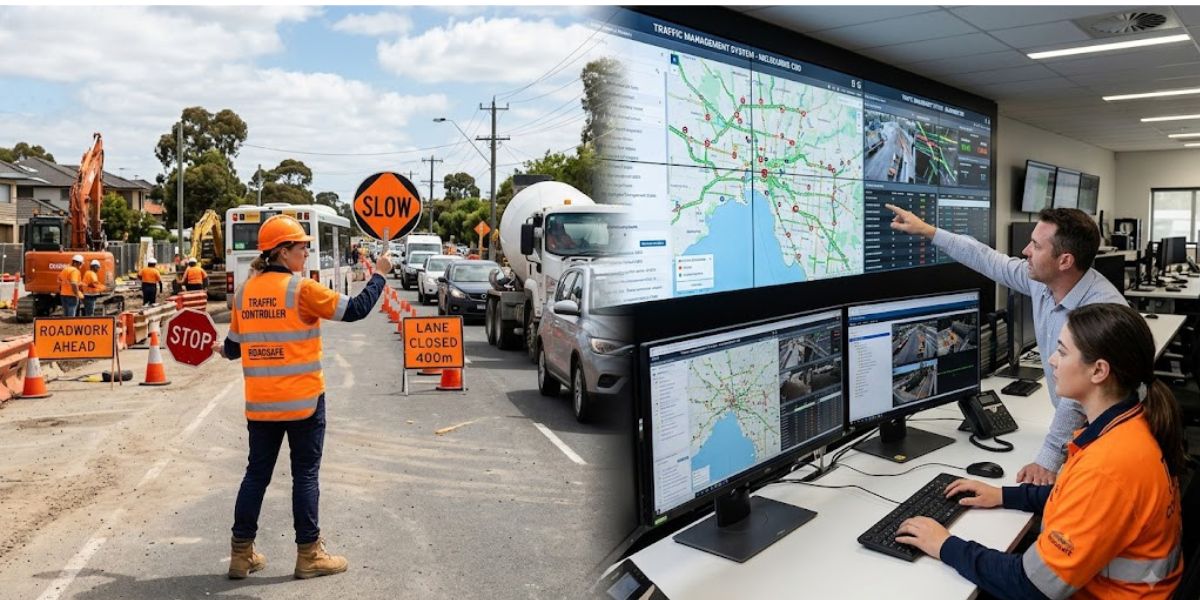
A traffic controller is a trained individual who manages the flow of vehicles and pedestrians at a specific point, usually at or near a worksite, road closure, or temporary hazard. Their job is hands-on and immediate. They stand at a designated position, often with a Stop/Slow bat, hand signals, or portable traffic lights, and direct drivers and pedestrians safely around or through a controlled area.
Traffic controllers are typically required to hold a recognized certification or license, since they are responsible for public safety in real time. Their core responsibilities usually include:
In short, a traffic controller is an operational role, a person physically present, executing a specific and narrow function within a broader safety plan. They don’t usually design the traffic plan; they execute it.
Traffic management, on the other hand, is the overarching discipline of planning, designing, implementing, and monitoring how traffic, vehicles, cyclists, and pedestrians, moves through and around a worksite, event, or public area over an extended period. It’s a strategic and administrative function, not a single task performed by one person.
Traffic management typically involves:
Traffic management is usually developed by qualified traffic management planners or engineers, often in consultation with civil engineers, project managers, and local authorities. It’s the blueprint that traffic controllers then bring to life on the ground.
The easiest way to understand the difference is this: traffic management is the plan; a traffic controller is a person who helps execute part of that plan.
Think of it like a stage production. Traffic management is the director, scriptwriter, and stage designer combined, they decide what needs to happen, when, and why. The traffic controller is the actor on stage, performing a specific, visible role within that larger production. Without the plan, the controller has no direction. Without the controller, the plan has no execution at street level.
Here’s a side-by-side comparison to make the distinction clearer:
| Aspect | Traffic Controller | Traffic Management |
| Nature of role | Operational, hands-on | Strategic, planning-based |
| Scope | A single point or short stretch of road | An entire project, site, or region |
| Duration | Typically shift-based, temporary | Spans the full project timeline |
| Key output | Safe, real-time direction of traffic | A documented, approved Traffic Management Plan |
| Who performs it | Certified individual traffic controllers | Traffic management planners, engineers, consultants |
| Focus | Immediate safety and compliance at a point | Overall flow, risk mitigation, and regulatory approval |
| Example task | Holding a Stop/Slow bat at a lane closure | Designing the detour route for a six-month road upgrade |
Confusing the two terms isn’t just a matter of semantics; it has real, practical consequences.
If you’re planning a construction project, event, or road closure, you need both elements, but they come from different places. You’ll typically need to engage a traffic management consultant or company to develop a compliant Traffic Management Plan first. Only once that plan is approved will you know how many traffic controllers you need, where they should be positioned, and for how long. Trying to skip the planning stage and go straight to hiring controllers often results in non-compliant, unsafe, or inefficient setups.
The qualifications required for each role are different. Becoming a traffic controller usually involves a shorter certification course focused on practical, on-site skills. Traffic management roles, such as traffic management planners or supervisors, generally require more extensive training, sometimes including engineering or planning qualifications, and a much deeper understanding of legislation, risk assessment, and design standards.
Regulatory authorities typically require an approved Traffic Management Plan before any temporary traffic control measures can legally be implemented. A traffic controller working without an underlying approved plan is not just poor practice, it can be a breach of workplace health and safety regulations, exposing the business to liability if an incident occurs.
In practice, the two functions are deeply interconnected and neither works well without the other.
This layered structure ensures that what happens on the road is never improvised. Every hand signal a traffic controller gives is, ideally, the execution of a decision made earlier in the traffic management process.
If you’re organizing a project that will affect road or pedestrian traffic, it helps to know which service to ask for:
Traffic controllers and traffic management are two halves of the same safety system, but they are not the same thing. A traffic controller is the visible, on-the-ground professional directing vehicles and pedestrians safely through a hazard zone. Traffic management is the broader planning, risk assessment, and regulatory process that determines how, where, and when that control should happen. Getting the distinction right and engaging the correct service at the correct stage of your project, is essential for safety, compliance, and avoiding costly delays.
No. A traffic controller performs the physical, on-site task of directing vehicles and pedestrians, usually with a Stop/Slow bat or hand signals. A traffic management planner develops the overall strategy, including the Traffic Management Plan, risk assessments, and regulatory approvals that guide where and how controllers are deployed.
In most jurisdictions, yes, any activity that temporarily affects normal traffic flow, even a short-term lane closure or a single afternoon of works, generally requires some form of approved traffic management documentation. Requirements vary by location and project size, so it’s best to check with your local road authority.
Yes, many traffic management companies offer an end-to-end service, developing the Traffic Management Plan, obtaining approvals, and supplying certified traffic controllers to implement it. This can streamline coordination, but it’s still useful to understand which stage of service you’re paying for.
Requirements vary by country and state, but traffic controllers generally need to complete an accredited traffic control certification course covering signals, safety procedures, and site setup. Certification usually needs to be renewed periodically.
Liability depends on the circumstances, but generally, if an approved Traffic Management Plan was in place and correctly followed, responsibility is shared according to each party’s role. If controllers were deployed without an approved plan, or the plan wasn’t followed, the responsible business or contractor may face greater liability.