

Making the right choice of Work Health and Safety (WHS) qualification can create a huge difference to your career direction and responsibilities along with future opportunities. In Australia, two of the major nationally recognized WHS qualifications are the BSB41419 Certificate IV in Work Health and Safety and the BSB51319 Diploma of Work Health and Safety.
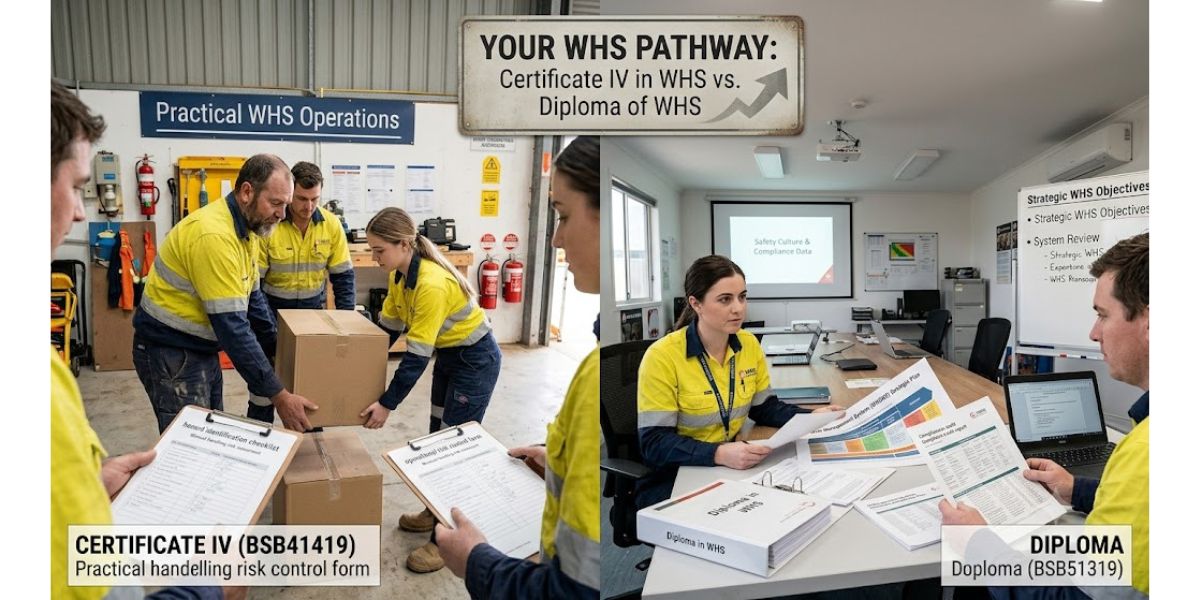
While both qualifications are developed for people working in workplace health and safety, they are targeted at different levels of responsibility. The Certificate IV offers practical and foundational skills for contributing to WHS activities whereas the Diploma is developed for people coordinating and maintaining WHS programs often in higher management positions.
Getting to know the difference between a Cert IV and Diploma can help you select a course that is aligned with your current experience and career goals.
The BSB41419 Certificate IV in Work Health and Safety is developed for people who are working in WHs roles who require technical knowledge and practical skills to handle workplace risks and contribute to WHS processes.
The qualification is ideal for WHS personnel and supervisors along with workers with WHS related responsibilities. It aims on applying WHS laws and handling risks and contributing to workplace safety within established organizational systems.
Major areas can include:
The Certificate IV has no formal entry needs listed on the national training register which makes it an ideal initial point for people entering the WHS field or formalizing their existing workplace safety experience.
The BSB51319 Diploma of Work Health and Safety is a higher-level qualification designed for people who coordinate and maintain WHS programs within organisations.
According to the national training register, the Diploma applies to supervisors and managers who use substantial knowledge and well-developed skills across a variety of WHS contexts.
The Diploma builds on the skills developed at Certificate IV level and prepares learners for greater responsibility in areas such as WHS program coordination, risk management, compliance, consultation and incident management.
Unlike the Certificate IV, the Diploma has specific entry requirements. Applicants must have completed the core units of BSB41419 Certificate IV in Work Health and Safety or demonstrate equivalent competencies.
The biggest difference is the level of responsibility and depth of knowledge.
| Feature | Certificate IV in WHS | Diploma of WHS |
| Qualification | BSB41419 | BSB51319 |
| Typical level | Foundational/operational | Advanced/management |
| Best suited to | New and developing WHS professionals | Experienced WHS professionals and managers |
| Main focus | Supporting and implementing WHS processes | Coordinating and maintaining WHS programs |
| Responsibility | Operational and supervisory | Senior, coordination and management |
| Entry requirements | Nil | Cert IV core units or equivalent competencies |
| Career direction | WHS Officer, Coordinator, Safety roles | WHS Manager, Senior Advisor, Consultant roles |
The Certificate IV is generally the better starting point, while the Diploma is more appropriate for professionals seeking to progress into higher-level WHS responsibilities.
A Certificate IV develops the practical knowledge required to support workplace safety. Students learn how to identify and manage workplace risks, understand WHS legislation and contribute to established WHS systems.
The qualification includes five core units and five electives under its current packaging rules.
Depending on the training provider and elective choices, study may cover areas such as:
This makes the qualification particularly useful for people who want to work closely with employees, supervisors and operational teams to improve workplace safety.
The Diploma takes WHS knowledge to a more advanced level. Instead of focusing primarily on contributing to existing systems, learners develop the capabilities needed to coordinate and maintain WHS programs.
This can involve broader responsibility for organisational safety processes, risk management, consultation and compliance.
The Diploma is particularly relevant when a role requires someone to look beyond individual workplace hazards and consider how WHS systems operate across an organisation.
For example, a WHS professional at Diploma level may be involved in reviewing safety systems, coordinating WHS activities, advising managers, supporting compliance strategies and helping organisations improve their overall safety performance.
A Certificate IV can provide a pathway into a range of operational and support-level WHS positions. Depending on the employer, industry and previous experience, potential roles may include:
The qualification can be particularly valuable in industries where workplace hazards and safety compliance are major priorities, including construction, manufacturing, logistics, warehousing, healthcare, mining and other high-risk environments.
However, the qualification itself does not automatically guarantee a particular job title or seniority. Employers may consider previous industry experience, additional training and the specific responsibilities of the position.
The Diploma can support progression into more senior WHS roles where professionals are expected to coordinate safety programs and provide higher-level advice.
Potential career pathways may include:
The Victorian Skills Gateway, for example, identifies occupational health and safety practitioner, WHS officer and safety consultant among potential roles associated with the Diploma.
The exact career outcome will depend on your experience, industry, employer and any additional qualifications you hold.
For most people starting their WHS career, Certificate IV is the logical first step.
The Diploma’s official entry requirements specifically require the core units of Certificate IV in WHS or equivalent competencies.
This creates a natural pathway:
Certificate IV → WHS experience → Diploma → Senior WHS responsibilities
If you already have relevant WHS/OHS qualifications or can demonstrate equivalent competencies, you may be able to meet the Diploma’s entry requirements without completing the full Certificate IV. You should confirm this with your registered training organisation before enrolling.
Not necessarily. The Diploma is a higher-level qualification, but that does not mean it is automatically the better choice for everyone.
If your goal is to enter the WHS profession or move into an operational safety role, completing a Diploma immediately may be unnecessary. A Certificate IV can provide the practical foundation you need.
On the other hand, if you already have WHS experience and want to move into senior advisory, coordination or management responsibilities, the Diploma may be more appropriate.
The best qualification is the one that matches your current experience and intended career path.
Yes. Completing both can create a structured professional development pathway.
You could begin with the Certificate IV to develop your foundational WHS knowledge and then progress to the Diploma as your experience and responsibilities grow.
This approach can be particularly useful if you want to build a long-term career in WHS rather than simply obtain a qualification for a single position.
Before enrolling, consider these questions:
If yes, the Certificate IV is generally the more suitable starting point.
If you have existing WHS experience, consider whether your current qualifications and competencies meet the Diploma entry requirements.
For operational WHS roles, Certificate IV may be appropriate. For senior coordination or management positions, the Diploma may better align with your career goals.
Always check current job advertisements in your preferred industry. Some employers may specify Certificate IV, while senior positions may ask for a Diploma or equivalent experience.
If your long-term goal is WHS management, completing Certificate IV and progressing to the Diploma can provide a clear development pathway.
The choice between a Certificate IV and Diploma in Work Health and Safety ultimately comes down to where you are now and where you want your WHS career to go.
The BSB41419 Certificate IV in Work Health and Safety is designed for people working in WHS and related roles who need practical technical knowledge, risk management skills and an understanding of WHS legislation and workplace processes.
The BSB51319 Diploma of Work Health and Safety is aimed at people who are ready to take on broader responsibility for coordinating and maintaining WHS programs and who can meet its Certificate IV-level entry requirements or demonstrate equivalent competencies.
If you are starting your WHS career, Cert IV is usually the better place to begin. If you already have the required foundation and are aiming for senior or management-level responsibilities, the Diploma may be the next step.
The Certificate IV focuses on developing practical WHS knowledge and skills for operational and support-level roles. The Diploma is a higher-level qualification focused on coordinating and maintaining WHS programs and is suited to supervisors and managers.
Generally, the Certificate IV covers a lower level of responsibility and complexity than the Diploma. The Diploma requires broader knowledge and is designed for people coordinating and maintaining WHS programs.
The BSB51319 Diploma has an entry requirement of all BSB41419 Certificate IV in WHS core units or equivalent competencies. Therefore, Certificate IV or equivalent competencies are required for entry.
Yes. BSB41419 has no formal entry requirements listed on the national training register, making it a potential starting point for people entering WHS.
Depending on your experience and employer requirements, potential roles include WHS Officer, Safety Officer, WHS Coordinator and other WHS support positions.
Potential career pathways include WHS Manager, Senior WHS Advisor, Safety Manager, WHS Consultant and other senior WHS or risk-related roles. Your experience and the requirements of individual employers will also influence your career opportunities.
It can be valuable if you want to progress into senior WHS, coordination, advisory or management roles. The Diploma builds on the foundation provided by the Certificate IV.
BSB41419 Certificate IV in Work Health and Safety and BSB51319 Diploma of Work Health and Safety are nationally recognised vocational education and training qualifications listed on the Australian national training register.