
Fire extinguishers are one of the first lines of defense when a small fire starts in a workplace, a commercial property or any other facility. But just attaching an extinguisher on a wall does not imply it will work when required. Fire extinguishers requires to be chosen appropriately and positioned along with full inspection and regular maintenance.
For businesses looking for fire extinguisher test and tag Perth, it is significant to understand that fire extinguisher maintenance is not exactly the same as electrical test and tag. Portable fire extinguishers are handled under fire protection servicing needs that includes AS 1851- Routine service of fire protection systems and equipment while AS 2444 includes the choice and location of portable fire extinguishers and fire blankets.
This article discusses what Perth businesses should know about fire extinguisher inspection along with testing and maintenance.
When people search for fire extinguisher test and tag Perth, they are generally looking for a professional service that checks their extinguishers and ensures they remain suitable and ready for use.
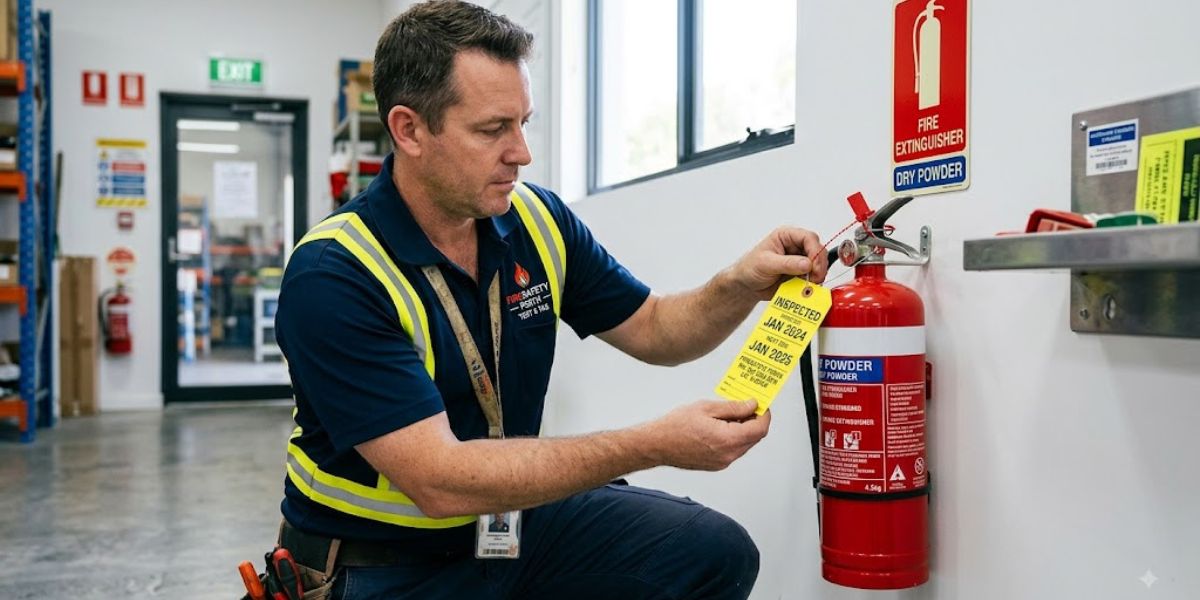
Fire-extinguisher maintenance involves more than placing a service sticker on the cylinder. Depending on the extinguisher type and applicable servicing requirements, a professional inspection can involve checking the extinguisher’s physical condition, pressure, components, accessibility, identification and service history.
AS 1851 establishes requirements for the inspection, testing, preventive maintenance and surveying of fire-protection systems and equipment. The Australian Business Licence and Information Service identifies AS 1851 as a standard covering these routine servicing activities in Western Australia.
An inspection looks for visible or operational issues that could affect the extinguisher’s performance. This may include damage, corrosion, pressure concerns, missing components, obstruction or evidence of previous use.
Servicing involves carrying out the maintenance activities required for the equipment and its applicable service interval.
Some extinguishers and components require more detailed testing at specified intervals. The exact requirements depend on factors including extinguisher type, condition, environment and applicable standards.
Maintenance information should be properly recorded so the business can track when equipment was serviced and identify any maintenance issues.
A fire can develop rapidly. If an extinguisher is damaged, discharged, inaccessible or otherwise unsuitable, valuable time may be lost during an emergency.
WorkSafe WA states that workplaces should have efficient portable fire extinguishers, ensure they are appropriately located and distributed, maintain them regularly and provide training to people who may be required to help control or extinguish a workplace fire.
Regular maintenance can help identify issues before an emergency occurs. It also helps businesses maintain records of their fire-safety equipment and demonstrate that appropriate maintenance processes are being followed.
For businesses operating in Perth, this can be particularly important where premises contain flammable materials, cooking equipment, electrical equipment, machinery, chemicals or other specific fire hazards.
Several Australian Standards may be relevant to portable fire extinguishers.
AS 1851 covers routine servicing of fire-protection systems and equipment. WorkSafe WA guidance lists AS 1851 alongside standards covering portable fire extinguishers.
AS/NZS 1841 covers portable fire extinguishers, including general requirements and specific requirements for different extinguisher types.
AS/NZS 1850 covers the classification, rating and performance testing of portable fire extinguishers.
AS 2444 covers the selection and location of portable fire extinguishers and fire blankets. WorkSafe WA’s workplace emergency-management guidance specifically references AS 2444 for extinguisher selection and distribution.
The requirements applicable to a particular property can depend on its use, fire hazards, equipment, building requirements and other circumstances. Businesses should therefore obtain advice from an appropriately competent fire-protection professional rather than assuming that one servicing arrangement applies to every property.
One of the most common questions is how frequently a fire extinguisher needs to be checked.
The answer can depend on the equipment, application and applicable requirements. AS 1851 includes scheduled maintenance activities at different intervals. WorkSafe WA guidance for fire extinguishers used on dangerous-goods vehicles, for example, states that AS 1851 nominates regular inspections at six-monthly, yearly and five-yearly intervals.
Certain premises can also have specific requirements. For example, WorkSafe WA guidance for petrol stations requires routine servicing of fire extinguishers at least every six months.
This is why businesses should not rely on a generic servicing schedule without considering their particular premises and equipment.
A professional fire extinguisher service can include a range of checks depending on the equipment and applicable service level.
A technician may inspect:
The precise procedure depends on the extinguisher type and applicable maintenance requirements.
A proper service should therefore be more than simply looking at the extinguisher and applying a new sticker.
Different fire risks require different types of extinguishing agents. Common portable extinguishers include:
| Water Extinguishers | Water extinguishers are generally intended for appropriate Class A fire risks involving ordinary combustible materials. |
| Foam Extinguishers | Foam extinguishers can be suitable for certain Class A and flammable-liquid risks, depending on their classification and application. |
| Dry Chemical Powder Extinguishers | Powder extinguishers are commonly used for a range of fire hazards and can be selected for particular flammable-liquid, gas and electrical-related risks depending on their rating and suitability. |
| Carbon Dioxide Extinguishers | CO₂ extinguishers are commonly associated with electrical equipment and certain Class B fire risks. |
| Wet Chemical Extinguishers | Wet chemical extinguishers are commonly used in commercial kitchens where cooking oils and fats create particular fire hazards. |
Choosing an extinguisher should be based on the actual fire hazards present rather than simply selecting the most familiar type.
Businesses should not wait for a scheduled service if an extinguisher shows obvious signs of damage or has been used.
Warning signs can include:
If an extinguisher has been discharged or damaged, it should be assessed and appropriately repaired, recharged or replaced rather than simply returned to its mounting location.
Even a fully functional extinguisher is of limited value if employees cannot reach it safely during an emergency.
WorkSafe WA has highlighted situations where fire extinguishers were moved to less accessible locations and emphasised the need to ensure locations and access comply with relevant legislation and Australian Standards.
Extinguishers should be:
Businesses should avoid placing equipment behind stock, furniture, machinery or other objects that could delay access.
Regular fire extinguisher servicing is relevant across many types of Perth properties, including:
Different environments can present different fire risks. A restaurant, for example, may require equipment appropriate for cooking hazards, while a workshop may have electrical equipment, fuels, oils or machinery that require different fire protection considerations.
For this reason, businesses should have their equipment assessed based on the hazards present at the property.
A typical professional servicing process may involve several stages.
The technician identifies the extinguishers present and records relevant information.
The extinguisher is examined for damage, corrosion, missing components and other obvious problems.
The technician carries out the applicable inspection, testing and maintenance procedures for the extinguisher.
Any equipment that is damaged, unsuitable or otherwise requiring attention is identified.
Where necessary and appropriate, equipment can be repaired, recharged or replaced.
Service information and relevant records are updated.
The extinguisher’s location and accessibility are checked to help ensure it can be reached when required.
The next scheduled maintenance requirement is recorded so the business can continue its servicing program.
Choosing a service provider should not be based purely on price. A low-cost service that does not properly identify defects or carry out required maintenance can create much greater problems later.
When comparing providers, ask whether they:
A professional provider should be able to explain what was checked, what issues were found and what action is recommended.
It is worth clarifying an important terminology issue.
Fire extinguisher servicing is not the same as electrical test and tag.
Electrical test and tag generally refers to the inspection and electrical safety testing of portable electrical equipment. Fire extinguishers are portable fire-protection equipment and are maintained under applicable fire-safety servicing requirements.
Therefore, businesses searching for fire extinguisher test and tag Perth should ensure they are engaging a provider that actually offers fire-extinguisher inspection and servicing rather than assuming that a general electrical test-and-tag service covers fire equipment.
There is no single price for fire extinguisher servicing because costs can vary considerably.
Factors can include:
A business with ten standard extinguishers requiring routine inspection will have different servicing requirements from a large industrial facility with numerous extinguisher types and additional fire-safety equipment.
The best approach is to request a site assessment and a clear quotation that separates routine servicing from additional repairs or replacement.
Fire safety maintenance is not something businesses should treat as a paperwork exercise. Properly maintained equipment can contribute to workplace safety and help demonstrate that reasonable fire-safety processes are being followed.
Businesses should also check their insurance policies and speak with their insurer or broker about any specific fire-protection maintenance conditions that may apply.
Maintaining accurate service records can make it easier to demonstrate the maintenance history of your fire-safety equipment when documentation is required.
Fire extinguishers are designed to provide rapid first-response protection when a fire is still manageable. But that protection depends on having the right extinguisher, in the right location, in usable condition and properly maintained.
For Perth businesses, regular fire extinguisher inspection and servicing should be part of an organised fire-safety management program. AS 1851 provides an important framework for routine servicing, while standards such as AS 2444 address extinguisher selection and location.
If you are unsure whether your extinguishers are correctly positioned, within their required service period or suitable for the hazards at your property, arrange a professional fire equipment assessment. Taking care of maintenance before an emergency occurs is far better than discovering a problem when the equipment is needed most.
Servicing frequency depends on the extinguisher, premises, application and applicable requirements. AS 1851 provides scheduled maintenance requirements, including different inspection and servicing intervals. Certain WA environments have specific requirements, so businesses should obtain advice appropriate to their property.
No. Electrical test and tag relates to portable electrical equipment, whereas fire extinguishers are maintained under fire-protection servicing requirements such as AS 1851.
Depending on the service requirement, checks can include the cylinder, pressure indicator, safety pin, tamper seal, hose, nozzle, mounting, service information, physical condition, accessibility and suitability.
Yes. An extinguisher can deteriorate even if it has never been discharged. Regular maintenance helps identify problems such as corrosion, pressure loss, damaged components or other defects.
Businesses should not rely on DIY maintenance for required servicing. Fire-protection equipment should be maintained according to the applicable standards and by appropriately competent personnel.
Replacement depends on factors such as its condition, age, service history, testing results, damage, corrosion and applicable requirements. A qualified technician can advise whether servicing or replacement is appropriate.